WalledCare is a camera-free radar sensor, one per room. It records room activity for your charting, shows night staff which residents are settled and which are up, and keeps families informed, so your team spends its time on care.
Every room checked, every observation written down. Time spent charting and walking the halls is time not spent with residents.
Average daily direct nursing and PSW care per Ontario long-term care resident in the latest reported year, short of the 4-hour target.
CBC Newsof nurses' time went to documentation in a 36-hospital study, nearly twice the time spent on direct patient care.
Hendrich et al., 2008 (hospital units)Residents notice the night shift too. In interviews with 30 nursing-home residents in Berlin, residents described night rounds as disturbing their sleep, and the authors suggested making rounds less frequent (Herrmann & Flick, 2012).
Sources: CBC News, Ontario long-term care care-hours target · Hendrich et al., Permanente Journal, 2008 · Herrmann & Flick, Pflege Zeitschrift, 2012
Got up at night, left the room, no movement for a set time. Recorded automatically and ready for charting, so staff do not write them down.
One screen, on a desk or on the wall, showing which residents are settled and which are up, so staff check the rooms that need it first.
A room that has gone quiet for longer than it should, or a resident who has left it, flagged to staff with nothing for the resident to wear.
After about two weeks, WalledCare knows each resident's usual pattern and flags clear changes, such as a morning that starts much later than normal.
Activity summaries for care-plan meetings, incident reviews and compliance inspections.
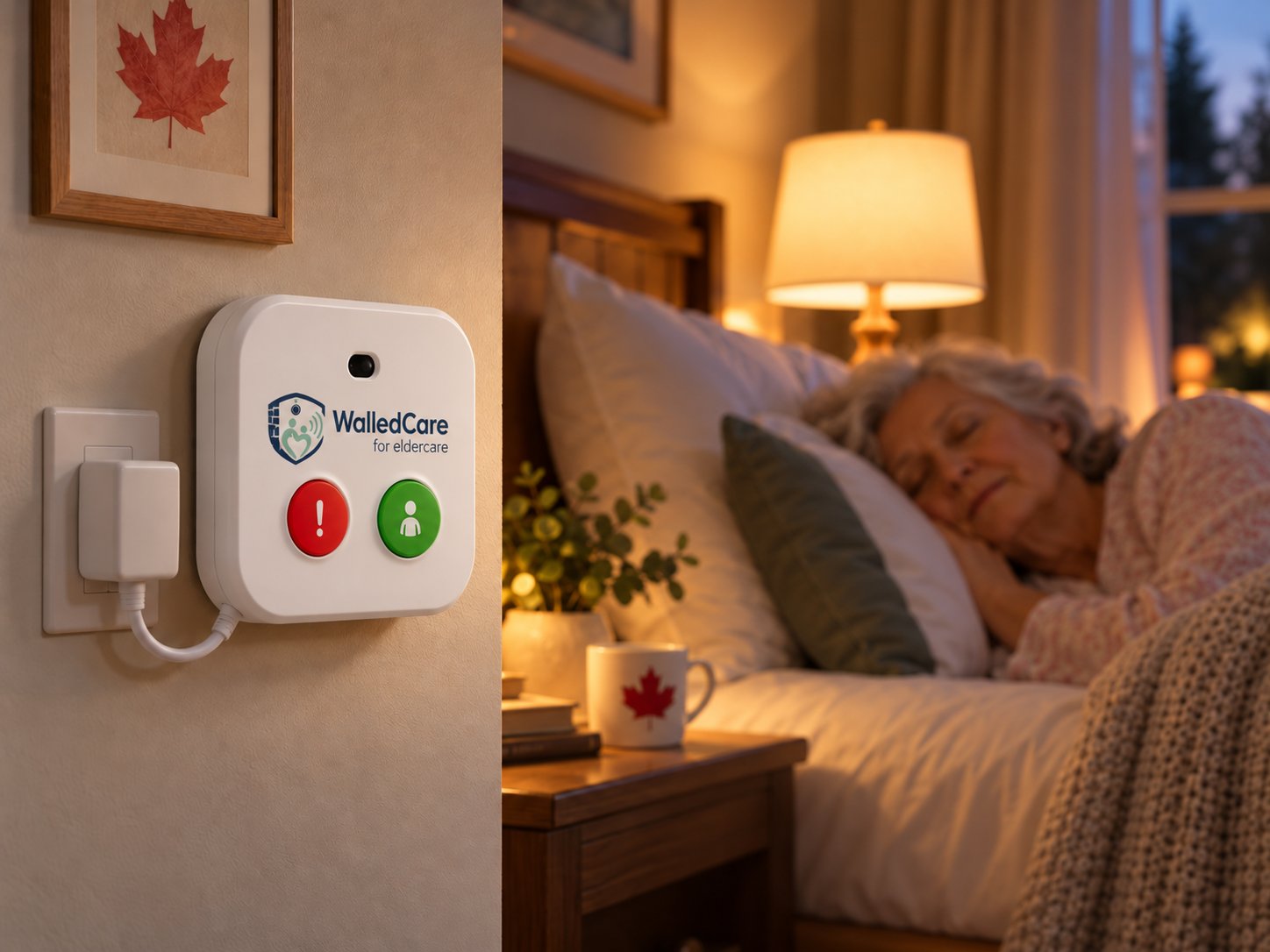
Green: staff check-in. A carer taps it on a visit and the visit is logged with its time. Red: help. One press alerts the people you choose.
A simple daily update for families that their relative was up and about, so fewer calls come to the desk.
Only the room that needs a look stands out.
No camera. No microphone. Nothing to wear.
Millimetre-wave radar senses movement and presence. No image or sound is ever captured, so it works in bedrooms and washrooms.
No pendant to forget, no wristband to charge, no device for residents to refuse.
Activity records are stored in Canada. There is no video or audio to store.
What it isn't. WalledCare is not a medical device and does not replace your nurse-call system, your care plans or emergency services. Use it alongside the tools and protocols you already rely on.
It mounts on the wall and needs a power outlet and the home's Wi-Fi.
About two weeks of normal routine, and each resident's pattern is known.
The night-rounds view, activity records and reports, on any computer, tablet or wall display.
For homes with 25 or more sensors.
One sensor per room. Nothing else to buy.
Prices in Canadian dollars. See all plans or book a demo for a quote for your home.
No. The night-rounds view helps staff decide who to check first and when a quiet look is enough. Your care plans and protocols still decide who is checked and how often.
No. The sensor is millimetre-wave radar. There is no lens and no microphone, so no image or audio is ever captured, stored or transmitted. That is why it can go in bedrooms and washrooms.
WalledCare works alongside your nurse-call system, not instead of it. Residents keep using nurse call exactly as they do today.
One sensor per room, plugged into a wall outlet, and the home's Wi-Fi. There is nothing for residents to wear and nothing to charge.
In Canada. Only activity signals and records are kept, never video or audio, because none is produced.
From $8 per sensor per month for homes with 25 or more sensors, plus $20 per sensor once for the hardware. See pricing.
No. It is an awareness and documentation tool. It does not measure breathing or diagnose anything, and it does not call emergency services.
Looking for a parent living at home? WalledCare for families →
