
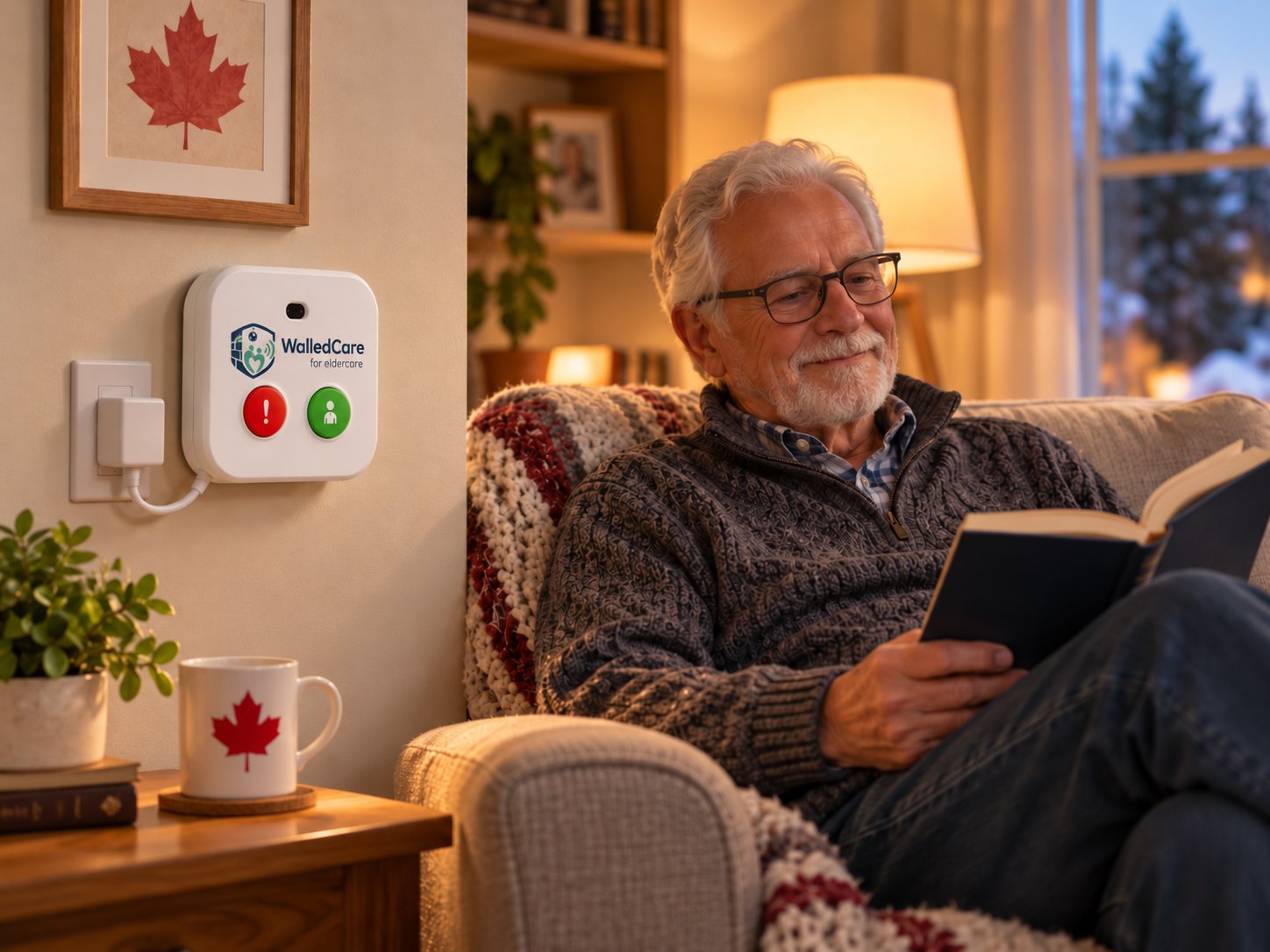
People do not start by searching for a sensor. They start at 11 p.m. after a phone call that did not get answered, or after the third time a parent has said "I'm fine" in a voice that says otherwise.
These pages are general information, not medical advice. If someone is hurt, or you think they may be, call emergency services.
Key facts
- Solo dwellers "represented 42% of all people aged 85 and older in private households", and living alone "was the living situation of 53% of women aged 85 and older in private households in 2021" (Statistics Canada, 2021 Census, 2022).
- Living alone does not cause a fall. It changes what happens after one, and that distinction is what most of this hub is about.
- A pendant that is not pressed does nothing. In a Cambridge cohort of 110 people aged 91 to 105, 80% of falls that happened when the person was alone and had a call alarm — 113 of 141 — passed without the alarm being used (Fleming & Brayne, BMJ, 2008). That is one UK cohort from 2008, and it says something about buttons, not about outcomes.
What to try before any device
The useful first steps are almost never a purchase:
- a conversation about what has actually changed
- an assessment through the provincial home-care service
- a grab bar
- a medication review
- knowing which changes matter and which do not
Monitoring technology comes after that, as one option among several — including the cases where it is the wrong option. Where a guide here recommends monitoring, it says what the monitoring would actually have noticed in the situation you are reading about, and what it would have missed.
Start with the worry
Each of these starts from the worry rather than the device, and you can read them without having decided to buy anything:
| The worry | Where to read about it |
|---|---|
| They have refused a pendant, or would not press one | Medical alert pendants and watches and radar presence sensors, which need nothing worn |
| The night, and the bathroom | Radar presence sensors for rooms a camera cannot go in, and acoustic monitoring for the care-home version of the same question |
| Nobody would know for hours | Radar fall-detection sensors — the claims, quoted, and what is behind them |
| Dementia and going out at night | GPS locators — what they do once someone has already gone out, and where they fail |
| Missed or doubled doses | Medication dispensers — what a locked dispenser fixes, and what the adherence evidence really shows |
| Nobody has heard from them today | Daily check-in apps — what one answered call a day catches |
| You want someone else to answer at 3 a.m. | Remote-monitoring services and home-care bundles |
| Loneliness as much as safety | Smart speakers and voice assistants — good company, not a safety net |
If you work in care rather than in a family
- Night checks in care homes — the trade-off between skin safety and broken sleep.
- Passive remote monitoring for home-care agencies — which reports the Canadian randomised trial honestly, including that it found no statistically significant reduction in admission to a higher level of care (Donelle et al., JMIR Aging, 2025).
Where to look next
Comparisons covers choosing between options, Canada covers the costs, the programs and the law, and the glossary defines the words a product page will use without explaining — long lie, ADL, PERS, prolonged inactivity.
Guides on the long lie, bathroom falls, dementia at night and the first 30 days after a hospital discharge are with a clinical reviewer.
In this section 2
Night checks in care homes: how often should a resident be checked at night?
Night checks in care homes protect skin and catch problems, but they break sleep. What the research, the 2026 Care England report and Ontario's rules say.
Read →Passive remote monitoring in Canadian home care: what the trial found, and how to write it into a care plan
Passive remote monitoring in Canadian home care: what the 2025 randomized trial found, why the evidence is still thin, and how an agency should write it into a care plan.
Read →
What we do not do
We do not diagnose, we do not tell you when it is time for long-term care, and we do not tell you that a sensor prevents falls. Nothing described in this hub — ours included — detects a fall, measures breathing, or replaces a person.
Where WalledCare fits
WalledCare is one option, and a narrow one. It plugs into an outlet, one unit per room, and reports presence, movement, prolonged stillness and prolonged inactivity for that room — enough to notice that someone is in a room and has stopped moving when they normally would not have, and to say so in plain words rather than a number. Nothing has to be worn, charged or pressed for that to keep working, and because there is no lens it can be in a bathroom. It does not detect falls, does not measure breathing, does not call anyone for help, and is not a medical device.